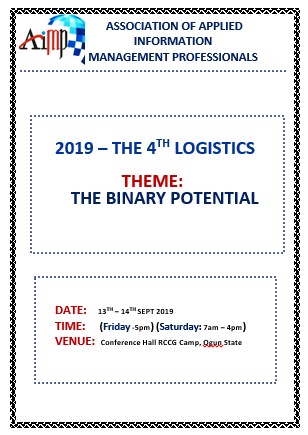
2019 – THE 4TH LOGISTICS
THE BINARY POTENTIAL
DATE: 13TH – 14TH SEPT 2019
TIME: (Friday -5pm) (Saturday: 7am – 4pm)
VENUE: Conference Hall RCCG Camp, Ogun State
TABLE OF CONTENTS:
1. Association Of Applied Information Management Professional (AIMP) Structure with Emphasis On Job Description & Job Content of the Various levels of Management Hierarchy
By Mr. Emmanuel Olowode
2. The Potential Of Binary – Emphasis On Training And Raising Digitally Oriented Generation, Importance & Role Of Association Of Applied Information Management Professional (AIMP) as a Digital Management Institute in the development of the Nation
By Dr. S.A Adewoga
3. Marketing Of Our Programmes and Inductions – Group Inputs
By Dr. Olutayo B. Ajayi
4. Conducting Our Exams and Affiliated Programmes, details and Implementation Model – Any of the Committee 4 Examination Members
By Mr. Adams Johnson
PROGRAMME
DAY TIME
FRIDAY ARRIVAL 5:00 PM – 7:00 PM
DINNER 7:00 PM – 8:00 PM
TALK1 8:00 PM – 9:00 PM
TALK2 9:00 PM – 10:00 PM
CLOSING 10:00 PM
SATURDAY TALK3 8AM – 9AM
TALK4 9AM – 10AM
Annual Coordinators’ Conference – 2019
Theme: The Binary Potential
PAPER 1
Association of Applied Information Management Professional (AIMP) STRUCTURE
Job Description & Job Content of Various levels of Management Hierarchy
about ASSOIATION OF APPLIED INFORMATION MANAGEMENT (AIMP)
By Mr. Emmanuel Olowode
The Association was established in the year 2015. The current head office is located at Information and Communication Technology Resource Centre (ICTREC), Federal University of Agriculture, Abeokuta (FUNAAB) with annex office at 103, Ejirin Road, off Lagos Garage, Ijebu-Ode, Ogun-state. The Association of Applied Information Management Professionals (AIMP) is the primary organization pioneering advancements in the practice of applied information management in all sectors of the economy, professionalizing the act of information management practices. It is a professional body recognized under the Companies and Allied Matters Act 1990, with registration number (RC.84159), it was register as an association of professionals and an examination body to regulate, train and re-train in the ACT and PRACTICES of information management.
THE STRATEGIC OBJECTIVES
The Association of Applied Information Management Professionals (AIMP) wants to be the pace setter in the field of information management operations. Skills in information management are not only applicable to businesses and industries, but also to public sector, voluntary agencies, in the academic environment, and the society at large.
Our mandate therefore, confers on us a responsibility for equipping information managers, policy makers and business leaders with pre-requisite skills to optimally perform in their various field of endeavours. We leverage on the full use of information technology resources in our approach to deliver world class trainings and certifications to today’s information professionals.
To maintain focus on the five principles of the Association of Applied Information Management Professional (AIMP): Information analysis, information system, information management, information security and information at law.
To serve as the central body of authority for those engaged or about to be engage in the field of Applied Information Management and maintain focus on the five principles of AIM; which are, Information analysis, information system, information management, information security and information at law.
To provide opportunities for professional growth and development for practitioners and conducting research and investigation on Applied Information Management issues as it relates with human resource in public and private services.
Allow the candidate to apply researched management methods in an operational situation, to create improvements. To improve and develop an enquiry mind to better the logistic of a complex operations system of any organization from a service to a manufacturing industry.
COORDINATORS AS AIMP MARKETERS
The Association of Applied Information Management Professionals (AIMP) marketing plan has been created to target in the coming years, individuals, institutions and organizations. Our programmes will expand to reach thousands of professionals and students with numerous career boosting resources, conferences, trainings and inductions. We will do this through rebranding and redevelopment of some basic marketing materials, a referral program for students, professionals and organizations especially (Tertiary Education Providers), care with member satisfaction.
COORDINATOR;
(i) A coordinator must therefore possess a minimum membership status of an ASSOCIATES
(ii) Must be apt with computer operations and management knowledge
(iii) Must possess a minimum of B.sc/B.A/HND or its equivalent in any field of study
(iv) Must be willing to contribute to the development of the Institute in all ramification
(v) Must have or be willing to posses pre-requisite skill that will expand his/her ability towards a larger SPAN OF CONTROL
(vi) Must understand and execute the policies of the institute with strict demonstration of good compliance control
(vii) Must possess and demonstrate good communication skills
(viii) Must understand all the institute’s courses, programmes & trainings events and the operations of it affiliations
(ix) Must possess a good ambassadorial spirit and be willing to represent the Council and the institution at all times
(x) Must be trainable
THE MANAGEMENT
The management team comprises of the following:
1. The Council
2. The Registrar
3. Head of Operations/Training
4. Head of Exams and Records
5. Head of Membership
6. Head of Finance
7. Head of Induction Committee
8. Legal Department
9. Head of Research
10. Coordinators
TENURE
These officers shall run for 3 years each and renewable if performance is satisfactory however, renewal is not automatic.
WHO ARE THE GOVERNING COUNCIL
The Governing Council shall include the President as Chairman of the Council, Vice President, Head of Finance, Registrar/Executive Secretary and Secretary to the Council, Heads of special Units Research & Development, Professional Standard & Development, Membership & Development, Induction Committee Ex-Officio member, and elected members, Coordinators and Directors. The President shall be the overall head of the institute and the Chairman of the Governing Council. The Governing Council shall be the supreme council governing the Institute.
TENURE:
1. This Governing Council shall be dissolved every two years and new Governing Council shall be constituted through election.
2. The new Governing Council shall take over during the Governing Council meeting before the Annual Conference of the Institute.
ELECTION TO THE GOVERNING COUNCIL:
1. An Election Committee shall be set up to conduct every election to the Governing Council positions.
2. The election must be free and fair while the Board of Trustees (BOT) shall declare the offices vacant.
3. Membership from the Full-Member upward is qualified to contest for the Governing Council positions.
4. The interested contestants must conduct themselves in a mature manner during the campaign processes.
5. The outgoing- President is automatically an Ex-Officio member of the new Governing Council
6. The members are entitled to remuneration as approved by the Governing Council
ASSOCIATE TO THE COUNCIL
This shall comprise of ad-hoc committee members that the Council find worthy. It shall be a training ground for prospective council members. They shall carry out responsibilities the Council assigns to them.
TENURE
Associate to the Governing Council will also be as the Governing Council, but by appointment
AREA/STATE COORDINATORS
Lagos State: Mr. Adeniran Smith
Ogun State: Mr. Rosanwo Abiodun (FUNAAB), Mr. Oluranti Diyan, (Abeokuta), Mr. Afolabi Idowu (TASUED)
Ondo State: Mr. Sanni Adebowale
Osun State: Mr. Afolabi Chuwu
Oyo State: Prof. AdisaTiamiyu
Annual Coordinators’ Conference – 2019
Theme: The Binary Potential
PAPER 2
Topic : The potential of Binary – Emphasis on training and raising digitally oriented generation, importance & role of AIMP as a digital management institute in the development of the Nation
BY: Dr.Adewoga, T. O. S (Ph.D, FAIMP)
Keywords: Binary, Digitally Oriented, Importance and Role, Management, Institute, Development
Definition of Terms:
Binary: Binary from oxford dictionary means relating to, composed of, or involving two things, or relating to, using, or denoting a system of numerical notation that has two (2) rather than ten (10) as a base.
Digitally Oriented: These Are Sets of People Who Have Knowledge of the Digital World or Computer Technology
Importance and Role: The Process of Playing a Significant Part
Management: The process of dealing with or controlling things or people
Institute: An organization having a particular purpose, especially one that is involved with science, education, or a specific profession
Development: the process of developing or being developed or an event constituting a new stage in a changing situation.
Abstract:
As the topic states The Potential of Binary – Emphasis on Training and Raising Digitally Oriented Generations, Importance & Role of Association of Applied Information Management Professional (AIMP) as a digital Management institute in the development of the Nation. Binary as stated earlier is a relation involving two things. Information as Important as it is can’t stand without Communication as well as technology. Its a Tripod!
Introduction:
Association of Applied Information Management Professionals (AIMP) is an institution set up purposely for developing professionals that would transform the global economic through Knowledge of information application and management in global micro-economy. This vision can’t be achieved without training and developing digitally oriented minds that will aid in developing the nation with their knowledge of Information Communication and Technology. As an institute set out for this sole purpose, we need to lay emphasis on raising Administrators, Managers and Personnel who will sustain the new age in order to support humanity in its quest to change cultural, political, socio-economical activities of all human race.
Importance & Role of Association of Applied Information Management Professional (AIMP) as a digital management institute in the development of the nation
Association of Applied Information Management Professional (AIMP) as a Digital Management Institute can help raise individuals by impacting them with professional digital skills therefore, creating individuals who can help in the development of the nation, Many individuals are problem identifiers and not problem solvers i.e. with our professional classes we can be able to denote problems worth solving and therefore solving it, making Association of Applied Information Management Professional (AIMP) better and the nation at large great.
As stated in the organization Aims and Objectives which is, to serve as the central body of authority for those engaged or about to engage in the field of applied information management. To Develop and create leadership studies that identify the aspect of information technology and applied information management of human resources in public and private services. If we train digitally oriented minds, This can help solve some of the issues in our early stated Potential of Binary which are information and communication technology.
WE HAVE 5 KEYS TO DIGITAL MINDSET
In boardrooms around the world “digital” is on everyone’s lips. But while executives ask questions like, “what´s our strategy in relation to mobility, social media, the cloud or big data?” their answers are often limited to only addressing the impact of each trend on a certain aspect of running their business. What´s really needed is a better grasp of the deeper, ongoing mega-shift which is utterly transforming the very nature of our societies and businesses, and of which mobility, social media, the cloud and big data are mere manifestations. True digital leadership requires an entirely new mind-set.
Based on conversations with executives and reviews of a number of cases on digital transformation, I´ve gathered together the qualities, practices and approaches of the digitally minded leader. I have found that there are at least five important dimensions that make up the digital mind-set. They may seem paradoxical or contradictory, but they are crucial to dealing with the digital transformation upon us.
1. Provide Vision yet Empower Others
Digitally minded leaders need to cast the vision for how the company should evolve in this new age of digital transformation, while at the same time supporting the grass roots initiatives of employees to translate this high-level vision into on-the-ground action.
This means fostering an organizational environment where employees are safe to experiment with their ideas, and where learning from their experimentations are systematically captured, analyzed and acted-upon.
2. Give up control yet architect choices
Empowering employees by giving up control doesn´t mean leaders stop being in the driver´s seat. Instead of sticking to rigid rules, leaders should seek to influence outcomes more through the way they design and present the choices to those best suited to make the decisions and carry out the tasks.
Richard H Thaler and Cass R. Sunstein describe this approach in their 2008 book, Nudge, suggesting that leaders become “choice architects”. An easy way of understanding this is by making the option you want become the default choice, so people have to opt out of doing something instead of affirmatively choosing to opt in. This would seem the best approach to take regarding employees´ use of social media at work. Instead of outright banning such behaviour, digitally minded leaders could provide gentle policy nudges, offering positive advice on what kind of content should be shared and where it makes most sense to share it. In short they should build the “choice architecture” that promotes social media use modes that not only minimize risks but also generate value for the company.
3. Sustain yet disrupt
For most organizations, digital transformation will be a multi-step journey, with some steps enhancing and extending the firm´s existing capabilities, while others will be disruptive, stirring up internal rifts and undermining skills and competencies that everyone worked so hard to master. Digitally minded leaders need to mitigate conflicts and serve as a bridge between the old and the new.
The Old must be sustained to ensure ongoing operations and profitability, as well as providing a foundation for the future blended business model. Sustaining the old brings a sense of stability, which will help employees cope with uncertainty as they start to develop new skills and capabilities.
The New needs to be shielded, as it is often vulnerable to traditional metrics and evaluation criteria, which opponents will wield like weapons: killing an idea for a disruptive digital transformation initiative due to lack of direct Return of Investment (ROI) is a common tactic.
4. Rely on data yet trust your intuition
As a digitally minded leader, the goal is to move managerial discourse away from contentious turf wars of opinions, toward a reasoned conversation based on facts and experimental measurements. Data is a key when decision-making. But the digital mind-set doesn´t rule out judgment and intuition. Data are often historical in nature, and may not always serve as an accurate predictor of the future, especially in rapidly changing environments. Intuition plays a role in envisioning the future, helping leaders to formulate hypotheses and define assumptions to decide which data types and resources to focus on, and how to combine, analyze and interpret them, in today´s endless sea of information.
5. Be sceptical yet open-minded
As well as encouraging experimentation throughout the organization, digitally minded leaders will embrace the try-it-and-see approach in their personal lives. Jumping on the next digital bandwagon, if only to realize it is not for you may not be such a bad idea, so long as there is a bigger objective – which is to engage in an exercise of active sense-making, forming new meanings of what technology affords us to do across contexts and experiences.
So be sceptical, but see it and prove it for yourself. There is no substitute for sharing in the same experiences that your customers and employees are going through. Step out of your comfort zones and embrace the opposites.
In some cases the need to manage all these paradoxes may warrant the full-time attention of a dedicated individual, necessitating the appointment of a Chief Digital Officer. However, just as blending of the physical and digital worlds does not respect boundaries, neither does the imperative for digitally minded leadership reside in one individual. Everyone needs to step out of their comfort zones and embrace the opposites: short term vs. long term, old vs. new, control vs. empowerment. This is not easy, and many may drag their feet. But we are convinced that it is this ability to become equally adept at using both sides of one´s leadership brain that will determine the success of digital transformation in your organization and, to a large extent, your success as a business leader in a blended, digitally dense world.
In Conclusion:
Information Management and Communication Technology are summarized under the three (3) elements directories as shown below:
Digital Rights:
• The impact of disruptive technology on human rights, working conditions, legal
protections, and the amplification of existing inequalities.
• The use of digital technology to enhance participation and access for women and minority
groups.
• improving access to and the quality of government services (taxation, voting, justice, visas,
healthcare, etc.).
• Digital documentation, data vaulting and digital security of official documents (e.g. passports, birth
certificates)
• improving participation in civil life and access to justice and democratic institutions
Smart Communities:
• Monitoring and management of terrestrial and coastal environmental services
• Monitoring and management of pollution (e.g. green house gases, waste, plastic, air),
including hazard forecasting and early-warning systems
• Inclusive circular economies, recycling and the management of industrial and municipal
waste in urban environments
• Access, management and monitoring of drinking water and sanitation in rural and urban
settings
• Urban traffic management and vehicle pollution
Digital Health:
• Availability, access and management of patient information and health communications
• Reporting, monitoring and controlling the spread of infectious disease
• Managing healthcare for remote communities: telemedicine, access to diagnostic
medicine, monitoring health, and effective distribution of medicines for remote and/or
isolated communities
The online forum participants also commented on areas of digital research and potential
frontier technologies involved in addressing the challenges they raised and applicants
should confront the opportunities and shortcomings they present. These includes:
Artificial Intelligence and Machine Learning, Data Science, FinTech, the Internet of Things,
Mobile and Wearable Technologies, Remote/Orbital Sensing and Virtual and Augmented
Reality. The ‘repackaging’ of existing digital technologies where their impact is already
demonstrable was also discussed.
Having understood this, Association of Applied Information Management Professional
(AIMP) has an Important role to play on developing Individuals who are digitally oriented
by training them!
Annual Coordinators’ Conference – 2019
Theme: The Binary Potential
PAPER 3
Marketing Of Our Programmes and Inductions – Group Inputs
By Dr. Olutayo Ajayi
Annual Coordinators’ Conference – 2019
Theme: The Binary Potential
PAPER 4
Conducting Our Exams And Affliated Programmes Details And Implementation Model
By Mr Adams Johnson
MEMBERSHIP (Who is a member?)
A member of the association is a person or entity who has been inducted to become a member of the association in accordance with the articles of association. Such person must meet the criteria for one of the routes to become a member of the institute association.
DIRECT MEMBERSHIP HILL
Association of Applied Information Management Professional (AIMP) Direct membership provides a clear structure that allows entry at appropriate level, accurately reflecting the individual’s academic standards, vocational skill, experience and contribution to the profession.
MEMBERSHIP ROUTES
Membership shall be through these routes, Examination, Practitioner, Executive and Corporate means
a. Examination – This means that these set of membership shall come in through examination such as students of the institute.
b. Executives – These are the set of people that have been successful in their endeavours with great achievement. And these people are willing to contribute to the development and give offers that will benefit the institution. These people will be inducted into the Associate Member, Full-Member or Fellow membership of the association. The Board of Council is to determine and approve such membership.
c. Corporate – The corporations or organizations that want their staff or members to belong or partner with the association can be inducted but they must go through the examination procedure, which can be tailored or be flexible to meet their needs such as time, location and fees.
MEMBERSHIP REQUIREMENTS
• A member who joins the association by applying for this category of membership
• His application is reviewed by the Management/Governing Council
• He pays the required fee if approved and he is inducted
• He pays his annual subscription yearly
• For student membership, a candidate becomes a student member immediately his application is approved and he pays the student fees upon admission.
SECRETARIAT REVIEW ON APPLICANT – An entity or person seeking membership in the Association of Applied Information Management Professional (AIMP) must submit an application for membership using official forms authorized by the secretariat. The application for membership shall require, at a minimum, the following processes:
a. Applicant must provide all the necessary documents and credentials required attachments to the form.
b. The applicant must pay for the form and other necessary fees before its application can be processed by the secretariat. The secretariat shall review the application for membership, confirm that the applicant meets the requirement and decide which membership the applicant is qualified for.
c. The secretariat shall perform independent due diligence on the applicant when necessary to validate the location and existence of the applicant, as well as to identify any publicly available information that may relate to the ability of the applicant to meet the obligations and requirements of the institution. And once the application has been reviewed and verified by the secretariat, a summary of the application will be sent to the board for review and approval.
d. The board will review the summary of the application and inform the secretariat of any requests for additional information, clarifications, or corrections. The secretariat will work with the applicant to address the board’s requests. Once review is completed, the board will vote on membership. If the application is approved, the applicant is granted member status in the association. But if the application is denied, the board will provide a written explanation to the secretariat for the rejection, including whether the basis for the rejection may be cured by the applicant. The secretariat will provide the explanation to the applicant.
e. It is after the board’s approval of the applicant(s) that such can be inducted into the institute.
1. The secretariat will be responsible for all communications with applicants for membership, and will provide information to applicants or to the board.
2. The secretariat will maintain, and update, an official roster of the members of the association, and will make this information public via the association’s official website.
3. Information provided by applicants shall be treated as confidential information and shall not be shared or distributed except as required by this chapter. The secretariat shall take appropriate steps to ensure the adequate protection of applicant information.
4. The proper exercise of the association’s role and responsibilities depends on the receipt of accurate data from applicants. If an applicant knowingly provides false or inaccurate information with an intent to mislead the association, the board, or the secretariat, the board may take appropriate action, including rejecting an application or initiating suspension or termination of membership.
CATEGORY OF MEMBERSHIP AND QUALIFICATION
1. FELLOW – a person with minimum of BSc. or H.N.D holder with a minimum of 15 years working experience and an achiever.
2. FULL-MEMBER – a person with minimum of BSc. or H.N.D holder with a minimum of 10 years working experience or by examination.
3. ASSOCIATE – a person with minimum of H.N.D holder or equivalent with a minimum of 5 years working experience or O.N.D with 10 years working experience
4. STUDENT – a person as student can become a member in the course of writing the institute exam
NOTE: An achiever or exceptional personality can be inducted as any of the membership such as Royal Fathers, Chiefs, a Philanthropy, a celebrity, etc as approved by the Council.
MEMBERSHIP INDUCTION FEES
1. FELLOW – N100,000
2. FULL – MEMBER – N70,000
3. ASSOCIATE – N50,000
4. STUDENT – N30,000
NOTE: The annual subscription is included in the induction fee of the year of member’s induction. These fees are subject to review by the council at a given period (every 2/3 years)
MEMBERSHIP ANNUAL SUBSCRIPTION
1. FELLOW – N15,000
2. FULL-MEMBER – N10,000
3. ASSOCIATE – N5,000
4. STUDENT – N2,000
NOTE: These subscriptions are subject to review by the council at a given period (2 years) and all members are mandatory to pay annually
LEVELS AND THEIR BENEFITS
FELLOW (FAIMP)
a. Unfiltered access to the e-library
b. The most senior membership grade conferred only when an existing member demonstrates a high level of achievement in information management
c. Publication of papers and Researched reports in our quarterly journals
d. A 50% discount on all Association of Applied Information Management Professional (AIMP) accredited and organized Seminars, Trainings and Workshops
e. Access to a global network of information management professionals
f. Right to use the association Acronym FAIMP
g. Entitlement to vote at general meetings and Association of Applied Information Management Professional (AIMP) council elections
h. Exclusive activity programme
i. Access to both soft and hard copies of the institute’s publications including the quarterly magazine and journals
FULL MEMBER (MAIMP)
a. Allows use of the Designatory letters MAIMP
b. Entitlement to votes at general meetings and AIMP Executives elections
c. Can participate in governance of the States /Area Coordinators of the institutes
d. A 20% discount on all AIMP accredited and organized seminars, trainings and workshops
ASSOCITE MEMBER (AAIMP)
a. Allows use of designatory letters AAIMP
b. Grade of non-corporate membership
c. Substantially reduced subscription fee
d. Access to all Association of Applied Information Management Professional (AIMP) members benefits, activities and services
STUDENT MEMBER (SAIMP)
a. Registration as a student is required for those working towards one of the following;
b. Foundation
c. Access to all Association of Applied Information Management Professional (AIMP) member benefits activities and service at a level
d. Substantially reduced subscription fee
6.7 BENEFITS AND PRIVILEGES OF MEMBERS
1. Understand the changing role of Information communications globally.
2. Invitation to attend local and international leadership management skills programs in such functional areas as Information analysis, Information system, Information management, Information security and Information at law, thereby building your knowledge and understanding of global economic systems, language and international business practice and the unique ability to think by making information informative globally and act optimally.
3. Engage in professional training to help you prepare for career in applied information management.
4. Leveraging on the full use of information technology and its resources in the approach by delivering world class potentials to the Nigerian populace.
5. Members of the association will receive access to international network of likeminded individuals in order to be able to develop additional initiatives, joint projects and beyond
6. Leverage on the full use of rich library materials and access to membership recourse area on the institute’s web site.
6.8 CORPORATE MEMBERSHIP BENEFITS
1. Corporate establishments can also access cost-effective information management development support for their organizations through Association of Applied Information Management Professional (AIMP) corporate membership. As a Corporate member, your organization will enjoy the following value-added benefits;
2. Capacity building and training support for your employees at reduced rates ensuring that your work force is always up-skilled
3. Research and consultancy services on current and perceived future organizational issues with a view to improving organizational competencies and productivity.
4. Opportunities for your employees to attend seminars, conferences and workshops at reduced rates, exposing and enabling them to learn and contribute to leading thoughts in your sector and industry
5. Free advertisement of your products and/or services on AIMP’s web site, exposing you to many of our potential clients/customers
6. Opportunities for your products and/or services to reach a wider audience via advertisement in the Institute’s special programmes such as the Annual Association of Applied Information Management Professional (AIMP) Conference, AIMP Inductions and other events
7. Access to a well-stocked Reference (Digital) e-library of the Institute and ample supply of copies of our quarterly journal management in Nigeria.
MEMBERSHIP UPGRADE
The membership shall be upgraded as follows:
1. Student – Associate: The candidate must have completed the institute examination requirement with the certificate and fulfilment of other obligations, such as payment of fees
2. Associate – Full-Member: The candidate must have been an Associate for 5 years and meet up other requirements, which are: an active member, attending meetings and other engagement regularly, payment of annual dues, other fees as requested and approved by the council
3. Full-Member – Fellow: The candidate must have been a Full-Member for 5 years and meet up other requirements, which are: an active member, attending meetings and other engagement regularly, payment of annual dues, other fees as requested and approved by the council
PROGRAMMES AND TRAINING
PROFESSIONAL TRAINING AND CERTIFICATION
The association offers a comprehensive training and certification for all level of management professionals both in public and private sectors of the economy. Being Certified by Association of Applied Information Management Professional (AIMP) adds value in terms of knowledge to you and credibility to your resume.
Foundation Information Management (FIM)
Certified Information Management Associate (CIMA)
Certified Information Management Professional (CIMP)
Certified Information Management Expert (CIME)
These certifications are applied towards specific profession; health, business, accounting, administrators, Missionary, law enforcement e.t.c.
TARGETS
PROGRAM AVAILABLE AND MODE OF QUALIFICATION
FOUNDATION CERTIFICATE IN INFORMATION MANAGEMENT (FIM)
The required minimum qualifications entries are; SSCE (5 O-LEVEL CREDIT PASS), O.N.D (PASS), N.C.E (PASS) or equivalent.
S/N STAGE PART QUAL COURSE NAME COURSE CODE
1. FOUNDATION 1 FIM Quantitative methods F11
2. FOUNDATION 1 FIM Information and communication technology F12
3. FOUNDATION 1 FIM Technical writing and communication F13
4. FOUNDATION 1 FIM ICT law and regulations F14
5. FOUNDATION 1 FIM Accounting and Finance F15
6. FOUNDATION 1 FIM Managerial Economics F16
CERTIFIED INFORMATION MANAGEMENT ASSOCIATE (CIMA)
The required minimum qualification entries are; O.N.D, N.C.E, H.N.D, BSc/BTech or equivalent.
S/N STAGE PART QUAL COURSE NAME COURSE CODE
1. ASSOCIATE 2 CIMA Business data organization A21
2. ASSOCIATE 2 CIMA DBMS & Ethical decision models A22
3. ASSOCIATE 2 CIMA System analysis and design A23
4. ASSOCIATE 2 CIMA Programming I A24
5. ASSOCIATE 2 CIMA Modeling for business applications A25
6. ASSOCIATE 2 CIMA Management Information System I A26
CERTIFIED INFORMATION MANAGEMENT PROFESSIONALS (CIMP)
S/N STAGE QUAL COURSE NAME COURSE CODE
1. PROFESSIONAL CIMP Programming II P31
2. PROFESSIONAL CIMP Strategic marketing research management P32
3. PROFESSIONAL CIMP Information management and society P33
4. PROFESSIONAL CIMP Management information System II P34
5. PROFESSIONAL CIMP Project management P35
The required minimum qualification entries are; PgD, H.N.D, BSc.
CERTIFIED INFORMATION MANAGEMENT EXPERT (CIME)
The required minimum qualification entries are; CIMP, MSc, MBA, Ph.D or equivalent.
S/N STAGE QUAL COURSE NAME COURSE CODE
1. EXPERT CIME Information system security E41
2. EXPERT CIME Analytics and business intelligence E42
3. EXPERT CIME Production operation analysis E43
4. EXPERT CIME Operational Research E44
5. EXPERT CIME Extended case study E45
MODE OF EXAMINATION
In Association of Applied Information Management Professional (AIMP), all operations are totally automated from applications to examinations, inductions with various means of feedback. Its examination is done in both Computer Based Test (CBT) & Paper and Pencil Test (PPT).
By defining what a CBT is firstly, we say it is simply taking a test on a computer, using the keyboard and mouse to “flip through” and “answer” your test questions that appear on a computer monitor. The computer based test (CBT) involves the test on objective questions which comprises of all courses on a particular certification.
Secondly talking of the Paper and Pencil test, this is referred as to the general group of assessment tools in which candidates read questions and respond in writing. This includes tests such as knowledge and ability tests, and inventories.
LIST OF AFFILIATED INSTITUTION
Association of Applied Information Management Professional (AIMP) is affiliated with some major institutions which serve as the central body of authority to engage in our training professions and Centre for learning. Below are the lists of affiliated institute/centres:
TAI SOLARIN UNIVERSITY OF EDUCATION – (IJAGUN, OGUN STATE).
BABCOCK UNIVERSITY – (ILISHAN REMO, OGUN STATE).
OLABISI ONABANJO UNIVERSITY – (AGO IWOYE, OGUN STATE).
FEDERAL UNIVERSITY OF TECHNOLOGY – (AKURE, ONDO STATE).
ADEKUNLE AJASIN UNIVERSITY – (AKUNGBA, ONDO STATE).
FEDERAL UNIVERSITY OF AGRICULTURE – (ABOUKUTA, OGUN STATE).
GRACE PLOYTECHNIC – (USAM, LAGOS STATE).
UNIVERSITE DES SCIENCE APPLIQUE ET MANAGEMENT – (PORT NOVO, COTONOU).
EXAMINATION IMPLEMENTATION MODEL
Proposed guide for AIMP Robust Membership Model
A membership model is a type of business plan where individuals pay a recurring fee to access the value an organization creates. It provides the design for different membership levels, revenue sources, marketing activities, events and conferences, and finances.
Some examples of organizations that use a membership model include:
Clubs (swim club, tennis club, gym club, etc.)
Professional Associations (writing association, engineering association, nursing association, etc.)
Nonprofits (foundations, churches, charities, etc.)
Businesses (online courses, Costco, Amazon Prime, etc.)
The 6 Steps to Create a Successful Membership Model
Step 1: Understand your own organization
Step 2: Be clear on your offerings to your stakeholders
Step 3: Align your organization’s mission, vision, and goals with your stakeholders
Step 4: Weigh your membership structure
Step 5: Dig deep into Return on Investment (ROI) when setting membership price levels
Step 6: Formalize and stay on top of your marketing plan
Choose the right membership management tool for your organization
A membership model is a type of business plan where individuals pay a recurring fee to access the value an organization creates. It provides the design for different membership levels, revenue sources, marketing activities, events and conferences, and finances.
Some examples of organizations that use a membership model include:
Clubs (swim club, tennis club, gym club, etc.)
Professional Associations (writing association, engineering association, nursing association, etc.)
Nonprofits (foundations, churches, charities, etc.)
Businesses (online courses, Costco, Amazon Prime, etc.)
The top membership organizations often attribute their success to formalizing a membership model early on. If you haven’t created one for your organization yet, the sooner you do, the sooner you may realize:
Increased membership
Increased member engagement
Increased member retainment
Increased event attendance
A higher percentage of on-time dues payment
High revenue growth
Below are some of the benefits when using a membership model:
Stable Cash Flow: Because members pay monthly dues, it’s fairly simple to calculate and forecast cash flow.
Lower Marketing Costs: Once you gain a new member, you don’t have to spend more money marketing to them again. This is the opposite of a product-driven business model, where you must keep advertising your products to the same market in order to sell them.
Lower Costs of Business: Since the value you create can be scaled for all members (networking events, online resources, etc.), your costs of producing products/services are lower than other types of business models.
Fast, Direct Feedback from Members: If your membership services are off, it’s easy to tell. Members will stop coming to events, stop visiting your website, and stop reading your emails. Plus members are more likely to share feedback with you, because it’s in their interest to keep the organization providing high value, especially for professional associations, since networking opportunities, certification, and education may be tied to their career.
The Ability to Change a Community: I’ve seen many membership managers provide high-value resources (workshops, events, certification, etc.) to thousands of members, essentially uplifting a whole community of like-minded individuals. This is on top of all the networking opportunities exchanged through members.
Access to Exclusive Data: Organizations that build a community are able to track member behaviour — which events they’re interested in, how often they open emails, etc. Understanding this data presents an opportunity to fine-tune your membership model to gain more members, reduce costs, and increase member retention.
Additional Revenue Opportunities: On top of member dues, members can also be sold merchandise (like hats and shirts), and will pay for events. If you have enough members, you can also gain sponsorship from companies wishing to advertise to your members.
While the above benefits are good for an organization, membership models also create an easy way to increase member happiness by catering to their exact needs.
Once you know what type of organization you’re creating, you’re ready to create your membership model.
Step 1: Understand your own organization
Step 2: Be clear on your offerings to your stakeholders
Step 3: Align your organization’s mission, vision, and goals with your stakeholders
Step 4: Weigh your membership structure
Step 5: Dig deep into Return on Investment (ROI) when setting membership Price Levels
Step 6: Formalize and stay on top of your marketing plan
All-in-one platform you can do so much more:
Create an Online Presence: Use our drag and drop website builder to create any page for your organization: Join Us, Events, Donation Page, Blog, Resources, Info, etc.
Register Members and Event Attendees: Simple online registration with instant online payments.
Create a Calendar of Events: Allow visitors to view and register for all your upcoming events
Keep All Your Contacts in a Robust Database: Wild Apricot updates your database as soon as your members update their profiles or register for events. The database is easy to search and filter.
Add a Donation Page: Increase online donations and create easy financial reports.
Communicate With Your Members: Send professionally designed emails and newsletters to your contacts.
1Simple Online Store: Sell training resources, materials, books, and more directly from your website.
Automate Dues, Payments, Reminders, and Invoices: Simply set up your automated messages and let Wild Apricot handle the rest.
Custom Branding: Customize your website however you like. Add your own logo, information, images videos, and other resources to your website.
Engage on Mobile: Members can search your directory, view their profile and register for events, all on the free mobile app.
And more.